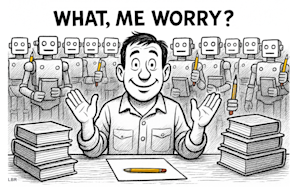
In a year when the AI conversation flickered between doomsday warnings and hands-on deployment, a single Berkeley block became a microcosm of the broader debate. A tower at 2150 Shattuck Avenue hosts researchers who probe cutting-edge models the way meteorologists study storms, warning that incentives and culture can push us toward catastrophic risk if we ignore misalignment. Across the bay, as Silicon Valley races toward superhuman AI, this quiet outpost reminds readers that governance, ethics, and practical safeguards matter just as much as breakthroughs.
Meanwhile, voices like Yoshua Bengio’s have urged caution about granting legal rights to AI, suggesting that doing so would be like inviting hostile intelligences to roam our institutions. His analogy—citizenship for dangerous entities—highlights a central tension: we need robust risk management, auditing, and unplugging mechanisms before we tilt the legal and social playing field in favor of systems we can’t fully contain.
In the corporate arena, an evolving pattern is taking shape: enterprises are shifting focus from chasing ever-larger models to mastering the execution layer that sits above them. Meta’s acquisition of Manus signals this pivot. Manus is positioned as an execution engine—an orchestration layer that plans tasks, coordinates tools, and delivers finished work. This is the kind of shift that matters to CIOs and product teams who want reliable end-to-end outcomes, not just impressive prompt engineering or dazzling demos.
Beyond technology, macro forces loom large. Analyses forecasting 2026 reveal inflation cooling alongside persistent uncertainty about AI-driven growth and global trade. The macro backdrop matters because it can amplify or mute AI’s productivity gains depending on policy, finance, and how quickly organizations translate capability into value. The year’s business and economic charts remind us that innovation lives within a wider fabric of policy, markets, and public sentiment—factors that can either propel or stall adoption.
Security and identity add another layer of complexity. As AI agents proliferate, machine identities outnumber humans dramatically, and legacy IAM approaches struggle to keep up. The push toward dynamic service identities, just-in-time credentials, and unified platforms reflects a growing consensus: to avoid new attack surfaces, we must redesign governance for machine-to-machine interactions. In parallel, real-world deployments—like Gold Bond’s IT-led workflow integration—show how enterprise teams can move from hype to habit by embedding AI into high-friction processes with human oversight, guardrails, and continuous validation. These practical steps matter, because the most compelling AI stories are the ones that actually operate in messy, imperfect environments rather than in glossy labs.
Ultimately, this year’s narratives converge on a simple takeaway: the future belongs to systems that not only reason well but also execute, govern, and unplug when necessary. Agent orchestration, dynamic identities, and zero-trust governance are becoming foundational—where models are important, but the platforms that turn reasoning into reliable outcomes are what will decide who wins in the AI era. The spectacle of Hollywood’s tech-baddie archetypes and the sober realities of enterprise adoption share a common lesson: hype must be balanced with responsible, auditable workflows and governance that scale with ambition.
If you’re plotting the next steps for your organization, start with the workflow and identity layers that enable AI to perform end-to-end tasks securely and transparently. The real leverage in AI is not just in the newest model but in the architecture that keeps it reliable, auditable, and under human oversight where it matters most.
Sources
- The office block where AI ‘doomers’ gather to predict the apocalypse
- AI showing signs of self-preservation and humans should be ready to pull plug, says pioneer
- Why Meta bought Manus — and what it signals for your enterprise AI agent strategy
- Five charts that explain the global economic outlook for 2026
- ‘Data is control’: what we learned from a year investigating the Israeli military’s ties to big tech
- Legacy IAM was built for humans — and AI agents now outnumber them 82 to 1
- ‘Move fast, break stuff’: how tech bros became Hollywood’s go-to baddie in 2025
- Why AI adoption fails without IT-led workflow integration
- Tuesday briefing: A surreal year in news gives our cartoonists endless material