Today’s AI news thread ties storage modernization to real-world AI readiness. The standout is Supermicro’s alliance aimed at removing storage bottlenecks that slow enterprise AI deployments. The industry is shifting from a simple capacity conversation to a strategic one: storage must be fast, scalable, secure and deeply integrated with AI workloads. Many organizations still run AI on architectures built before the AI era, making this modernization both urgent and complex. As SiliconANGLE reports, the partnership signals a broader push to align storage design with the needs of live AI inference and training.
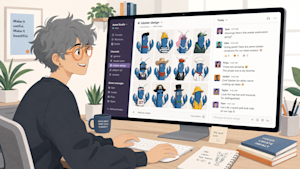
In the workplace automation landscape, the arrival of NanoClaw on Slack is making a real difference. VentureBeat describes how enterprise teams can spawn persistent AI agent teams from a single message. Each agent gets its own identity—name, avatar, memory and permissions—and can operate in Slack channels, shared Canvases, and even across other platforms like Telegram or WhatsApp. The design aims to avoid “subagents that disappear after one task” and instead enables a collaborative digital department where agents with specialized skills coordinate on routines such as code reviews, content planning, and testing. As CEO Gavriel Cohen notes, this is agents arriving natively in Slack for the first time, turning Slack into a launching pad for a growing ecosystem of automated teammates.
Salesforce’s Slack Code then takes agentic teamwork a step further by enabling coding agents to operate openly within teams. The rollout aims to bring coding agents into collaborative workflows where everyone can see what’s happening at the conversational layer. It sits alongside other approaches to persistent AI teammates—Anthropic’s Claude Tag, OpenAI’s ChatGPT Workspace Agents and Salesforce’s Agentforce—each with distinct governance and provisioning models. The NanoClaw approach, however, introduces recursive provisioning: a single Slack agent can spawn additional named agents with their own identities, memories and toolsets, all running on the customer’s own infrastructure.
On the automation frontier, Serval’s Catalyst positions an admin-facing “super agent” as the orchestrator of end-to-end automation. Catalyst can analyze historical tickets and SOPs, draft workflows, create onboarding paths and access policies, and even empower background agents that monitor systems for issues before a ticket is opened. In this view, Catalyst compresses the automation lifecycle into a single conversational surface, while the surrounding platform handles governance, permissions and data boundaries. Early deployments from Ramp, Mercor and others illustrate tangible gains—ranging from faster workflow creation to broader adoption across desks not traditionally focused on IT. This combination of AI-enabled discovery and automated execution raises the bar for what enterprise automation can look like when the human in the loop remains empowered but less burdened by routine tasks.
Beyond the enterprise, the day’s coverage spans hardware, software, and policy. Nvidia’s SONIC model offers a path for humanoid robots to move with real-time human demonstrations, while Adobe expands Firefly’s audio capabilities to include music, speech and sound effects for creators. In policy circles, questions about AI-enabled glasses surface as UK cinemas weigh bans to curb piracy risks, and academic and corporate voices debate AI’s influence on minds and bodies. On the funding side, Veeda AI’s seed round underscores continued investor excitement about world-model approaches, and debates around responsible AI remain amplified as UC Berkeley and others reckon with AI’s impact on editorial and student outcomes. Taken together, these stories illustrate how AI is shifting infrastructure, collaboration, governance and everyday life—from the data center to the desk and beyond.
- Supermicro alliance tackles the storage bottlenecks holding back enterprise AI — SiliconANGLE
- Meta AI Now Available as a Desktop App for Mac — AI Business
- NanoClaw comes to Slack, letting you create persistent AI agent teams and colleagues from a single message — VentureBeat
- Salesforce introduces Slack Code to bring agentic team coding into the open — SiliconANGLE
- Adobe expands generative AI audio with Firefly music, speech and sound effects — SiliconANGLE
- UK cinemas look at banning Meta smart glasses over piracy fears — The Guardian
- Serval’s super agent Catalyst creates roving background agents to identify and fix IT issues before they’re ticketed — VentureBeat
- Nvidia’s SONIC Teaches Humanoids to Move — AI Business
- Frustrated GP patients hang up as Yorkshire accent baffles AI receptionist — The Guardian
- It used to be our imperfect bodies that made us insecure. With AI, it’s our minds as well — The Guardian
- GOP urges top AI firms to do something about the toxic image of data centers — SiliconANGLE
- Sanja Fidler’s world model startup Veeda AI raises $90M in seed funding — SiliconANGLE
- UC Berkeley professor admits to using AI to edit op-ed on students’ math skills — The Guardian
-
AI Agents Reshape Enterprise: From Klarna to Gemini 3 and Windows
AI agents are moving from experimental labs into the heart of business and consumer technology, rewriting how work...
-
AI News Roundup: ChatGPT ads, AI-driven hiring, and tools that weave AI into daily work
Today’s AI news reads like a map of the near future: monetization experiments, culture-shaping AI, labor challenges in...
-
AI Regulation, Diversification, and the New Normal for Enterprise AI
Across the technology landscape, a new consensus is slowly taking shape: AI is moving from a rapid-fire innovation...